
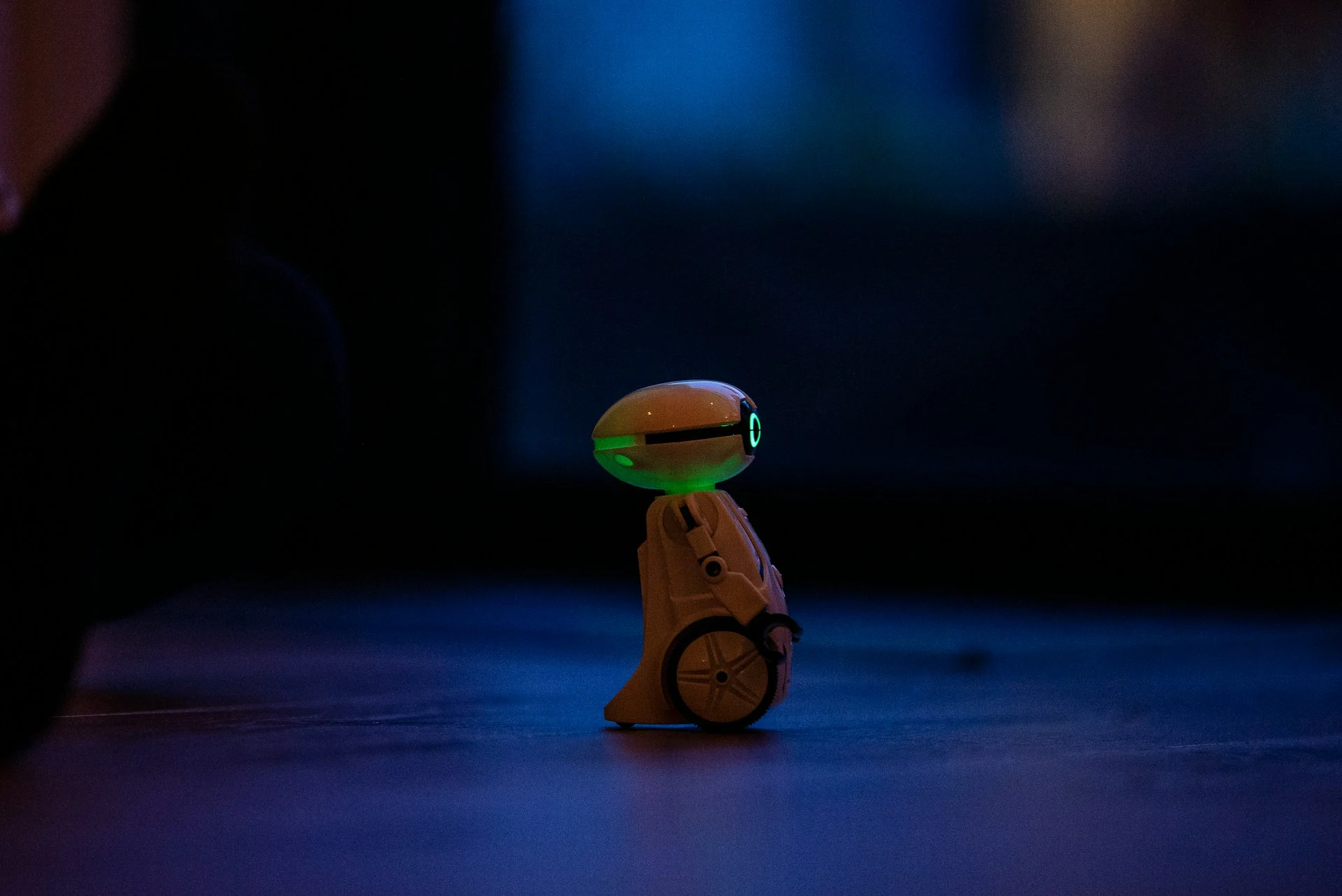
The Microduck robot duck is a 25cm, roughly 800g walking robot that learned to walk in a simulator rather than from hand-written motion code. Its maker, Pollen Robotics, the Hugging Face-owned robotics team in Bordeaux, has published the duck’s full software stack and its reinforcement learning (RL) training pipeline. Anyone with a GPU can now teach it new tricks.
Pre-orders opened on 27 August 2026 at an introductory $399. A dev.to write-up on 20 October 2026 brought the open-source code back into the spotlight, so here is what the duck can do, what is actually open, and why it matters.
Key takeaways
- Microduck is a bipedal robot about 25cm tall and under 800g, with 15 motors, a camera, an 8×8 depth sensor and two motion sensors.
- Walking, getting up after a fall, picking things up with its beak and roller-skating are all policies trained with reinforcement learning in simulation.
- The robot runtime and the training code are open source under Apache-2.0. The hardware design is not.
- The introductory price is $399, with first deliveries targeted before Christmas 2026 in North America, Europe and the UK.
What is the Microduck robot duck?
Think of it as a lab instrument that looks like a toy. According to The Next Web, it runs on a Rockchip RK3566 chip with 1GB of RAM and 32GB of storage, and a removable 2,600mAh battery gives it about an hour of play.
Its control loop runs at 50Hz, meaning the robot reads its sensors and picks new motor commands 50 times a second. It cannot hold a conversation. Pollen pitches its earlier Reachy Mini desktop robot as built for interaction and Microduck as built for action, so it beeps and plays melodies instead of chatting.
What can it do out of the box?
TechCrunch and IEEE Spectrum both list the same core behaviours. The robot ships knowing how to:
- Walk and steer with a gamepad.
- Get back up after a fall.
- Crouch, sit and stand.
- Bend down and grab small objects with its beak (Pollen’s Santiago Pavon put the lift limit at roughly 100g).
- Roller-skate on optional wheeled feet, which switches it to a second, separate RL policy.
You can also drive it with NFC-tagged objects or let it run autonomous behaviours, and several ducks can race or play football together. Pavon told The Next Web that real autonomy is “something we are still working on”, with the community expected to contribute.
How does the reinforcement learning pipeline work?
Reinforcement learning means the robot learns by trial and error. It gets rewarded for good outcomes, like moving forward without falling, and slowly improves. Doing that on a real robot would wreck the servos, so the trial and error happens in simulation.
The microduck_rl repository is built on mjlab, which runs on MuJoCo Warp, a GPU-accelerated version of the MuJoCo physics engine. It trains with PPO (Proximal Policy Optimization, a standard RL algorithm). The default walking task runs 4,096 simulated ducks in parallel, and the README estimates one to two hours for a usable gait.
The finished policy is exported to ONNX, a portable neural network file format, and the robot’s runtime loads it. You can also publish your trained policy to the Hugging Face Hub with one command.
The interesting part is the sim-to-real work. A simulator is a perfect world, and real robots are not. So the training randomises battery voltage, voltage sag under load, command delay and friction, and adds about one degree of gear play (backlash) to each servo joint. It is like training a runner on sand, ice and gravel so race day on tarmac feels easy.
One catch: training needs a CUDA GPU from Nvidia. If you have been following the fight over that dependency, our piece on Amazon TorchNeuron and the CUDA moat explains why it matters.
What is open source, and what isn’t?
This is where the “open-source robot” headlines need a footnote. Here is the split, based on the two GitHub repositories and Pollen’s own press guidance.
| Part | Status | Licence |
|---|---|---|
| Robot runtime (Rust services) | Open | Apache-2.0 |
| RL training code (microduck_rl) | Open | Apache-2.0 |
| 3D model files in the RL repo | Published, non-commercial | CC BY-NC-SA 4.0 |
| Mechanical and electronic design | Closed | Not released |
Pollen’s press kit asks reporters not to call Microduck open-source hardware, and a company representative told The Register there are no plans to open the design. So you can rewrite its brain, but you cannot legally build your own body for sale.
Why is the software design worth a look?
The main microduck repository is a Rust workspace split into small services: robotd runs the 50Hz control loop, updaterd installs signed updates and rolls back bad ones, mediad streams the camera over WebRTC, and others handle Wi-Fi, Bluetooth, the gamepad and the depth sensor. They talk over JSON-RPC on Unix sockets.
Only robotd can move the motors. Everything else sends requests that pass its safety checks first. In my opinion, that is the most reusable idea here: a clean, auditable split between “wants to move” and “allowed to move”, in a codebase small enough to read in a weekend.
What happens next
Pollen is targeting first deliveries before Christmas 2026. Until then, the RL repo works on its own: you can train and test policies in simulation without owning a duck. Pollen says some specs, including camera resolution, depth sensor range and SDK languages, are still provisional, so check the final spec sheet before you order.
The bigger test is the community. Pollen says Reachy Mini has sold more than 10,000 units, and CNX Software notes the same play: cheap hardware plus open code, so outsiders build the behaviours. If shared policies start piling up on the Hugging Face Hub, Microduck becomes a common benchmark for small-robot RL. If not, it stays a very cute demo.
FAQ
How much does the Microduck robot duck cost?
The introductory pre-order price announced on 27 August 2026 is $399 before taxes and shipping. An optional accessory pack adds wheeled feet, a ball, NFC tags and a laser pointer.
Can I train Microduck without owning one?
Yes. The microduck_rl repository trains and tests policies entirely in simulation. You need a CUDA-capable Nvidia GPU, and a basic walking gait takes about one to two hours to train.
Is Microduck open-source hardware?
No. The software and training code are Apache-2.0, but the mechanical and electronic designs are closed, and Pollen has said it has no plans to open them.
Want to see how far 4,096 simulated ducks get in an hour? Clone microduck_rl, run the default walking task, and watch a gait appear from nothing.
1 comment